THE SHORT ANSWER
Use Jev when the answer space is known before the call.
Give the model shared state and one or more typed questions. Use Choice for named alternatives, Score for an ordered rubric, and Noul for a yes-or-no probability. Your application—not the model—owns thresholds, permissions, side effects, and fallbacks.
ambiguous state→bounded decisionEvidence note: product shape and limits come from the current documentation. Performance numbers should be treated as provider-reported unless an independent, reproducible test is linked.
CODE, JEV, OR LLM?
Choose by the output you need.
Exact and repeatable
Use rules, schemas, regex, SQL, or a conventional classifier when the decision is lexical, mathematical, policy-table driven, or must replay identically.
Examples: parse an order ID, check an allowlist, calculate a date.Semantic but bounded
Use Jev when input is ambiguous but every legal answer can be declared up front and your code can act on a probability.
Examples: choose a tool, score urgency, judge whether evidence supports a claim.Open-ended and generative
Use an LLM when the system must write, explain, plan, produce code, or invent a value that is not already in the allowed answer space.
Examples: draft a reply, create a plan, explain a diagnosis.Try deterministic code first. Use Jev for the fuzzy bounded judgment. Escalate low-confidence or high-impact cases to an LLM or a person.
AGENTS & WORKFLOWS
Keep the loop fast and the action space explicit.
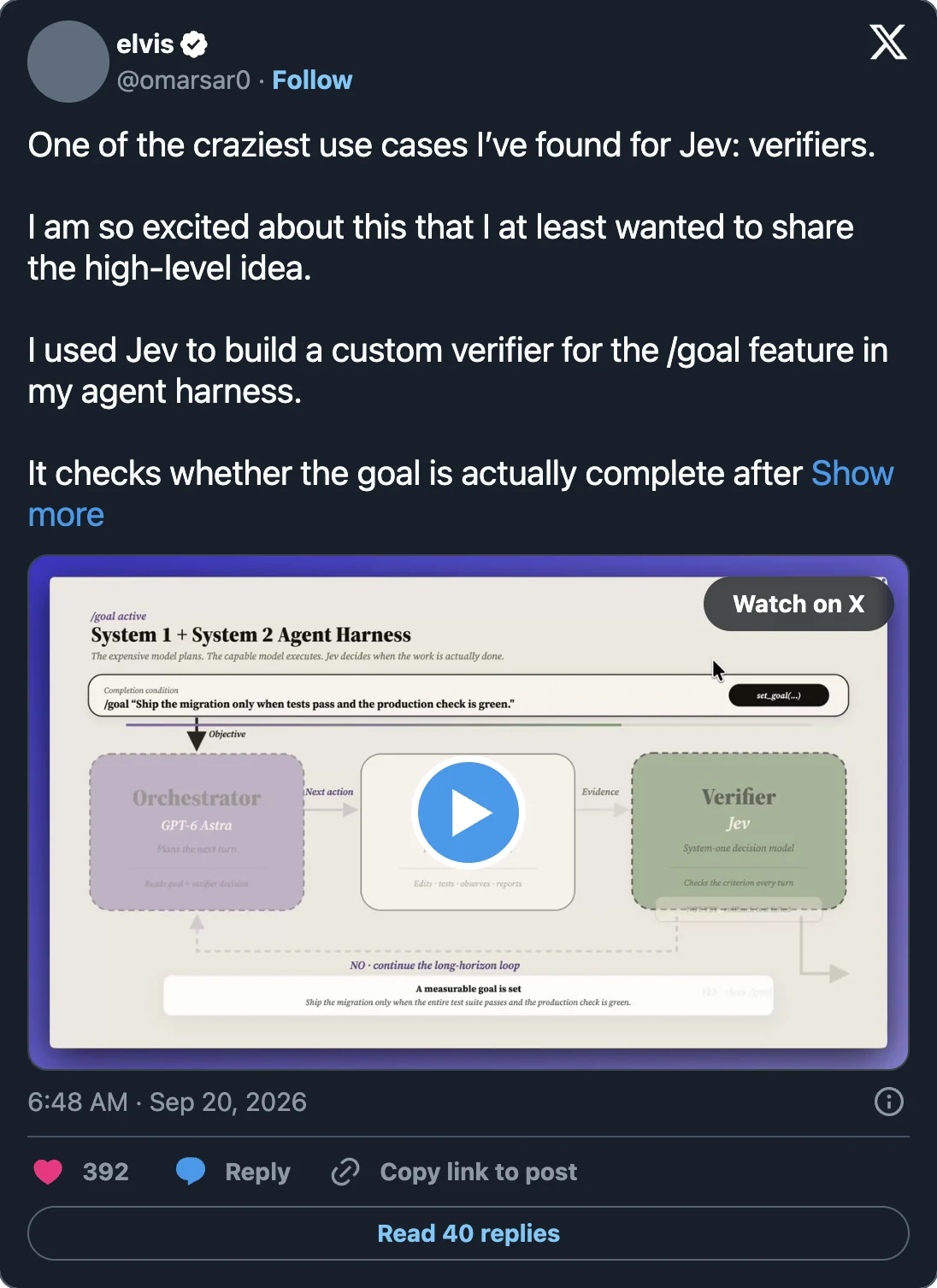
Agent completion verifier
After an agent says a goal is complete, ask whether the observed result satisfies each acceptance criterion. Code decides whether to finish, retry, or request review.
Noul cluster · state: goal + evidence + latest resultTool and function selection
Choose from tool names your application already exposes. Ask a separate Noul question for whether any tool should run at all.
Choice + Noul · never treat selection as authorizationModel routing
Classify intent and difficulty, then route to code, a low-cost model, a stronger model, or a human queue. This is especially useful when generation is needed only for a minority of requests.
Choice + Score · tune the escalation threshold on real trafficSkill or subagent routing
Rank a bounded roster of skills against the current task, then load only the best candidates. Include “none applies” as a separate gate.
Choice + Noul · state: goal + short skill descriptionsConfidence-gated workflow
Act automatically above a tested threshold, ask for confirmation in the middle band, and stop or escalate below it. Higher-risk actions deserve stricter gates.
Any primitive · policy stays in deterministic codeWHAT BUILDERS ARE TESTING
RAG & RETRIEVAL
Judge the evidence before generation.
RAG passage filtering
Ask whether each retrieved passage is relevant, trustworthy, conflicting, or prompt-injected before it enters the generation context.
Noul questions · probabilities become filter thresholdsSemantic reranking
Score a short candidate list against the query after keyword or vector retrieval. Sort by probability rather than asking for generated rankings.
Noul or Score · use retrieval to narrow firstCitation verification
Check whether a cited passage supports, contradicts, or is irrelevant to a claim. Exact quote matching should still be done in code.
Choice · claim + surrounding source textEntity alignment
Judge whether two records describe the same product, company, or person after deterministic blocking produces plausible candidate pairs.
Score + Noul · keep ambiguous matches for reviewSAFETY & QUALITY
Turn a written policy into reviewable signals.
LLM input and output guardrails
Screen prompts before generation and outputs before delivery for defined hazards. The probabilities inform pass, review, block, or crisis paths.
Noul + Score · test false negatives on your own policy setLLM-as-a-judge alternative
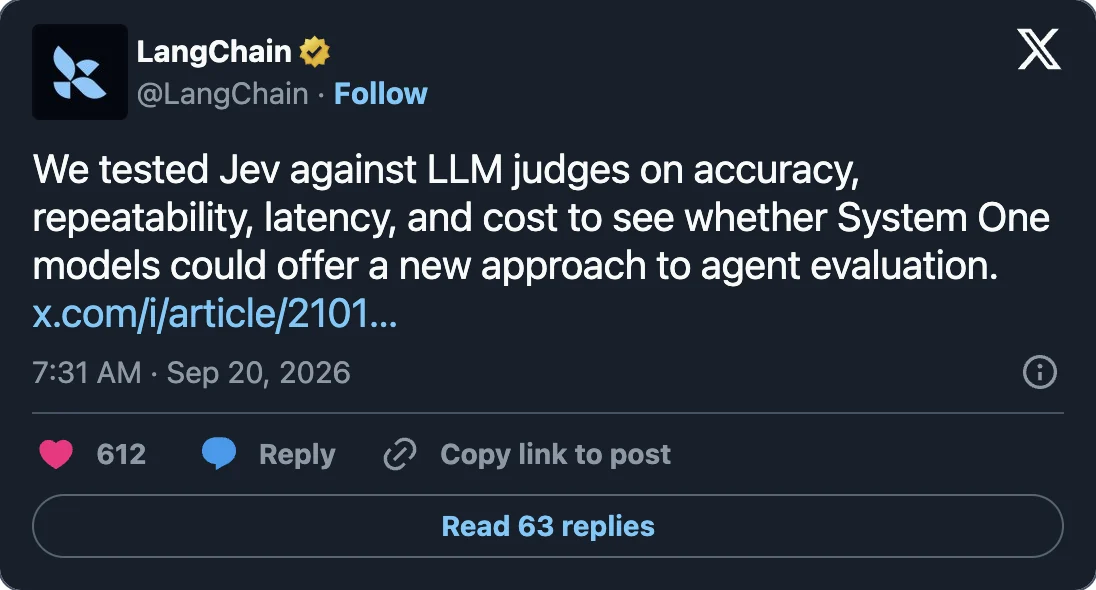
Evaluate agent traces or model outputs against a fixed rubric without requesting a prose critique. Use an LLM only when you need an explanation.
Choice + Score · repeated evaluation benefits from typed outputSemantic code linting
Check a diff against natural-language rules that ordinary linters cannot express, then comment only above a conservative probability threshold.
Noul · never replace compiler, tests, or static analysisCompliance checklist
Evaluate a changing document against a stable set of questions in one request. Automatically clear obvious cases and route borderline findings to a reviewer.
Noul + Choice + Score · retain source text and model versionDATA & OPERATIONS
Convert messy text into values downstream systems can use.
Support inbox triage
Classify the queue, score urgency and frustration, and estimate refund intent in one shared-state request.
Choice + Score + Noul · one call, several independent signalsHierarchical classification
Walk a large taxonomy one node at a time instead of putting thousands of labels in one question. Preserve multiple candidate paths when the probabilities are close.
Choice · useful for catalogues and document typesCandidate-based extraction
Let a parser or regex find candidate spans, then ask Jev which candidate answers the question. Copy the selected span unchanged.
Choice + Noul · not general free-text extractionComposite scoring
Score separate dimensions such as urgency, value, risk, and fit. Combine them with weights your application owns so the final ranking can be explained and retuned.
Score · avoid hiding every judgment inside one overall numberFeature extraction for ML
Keep question probabilities as numeric features beside your existing structured columns, then validate whether they improve a downstream model.
Noul + Score · evaluate leakage, drift, and calibrationPRODUCTION CHECKLIST
Do not ship the demo. Ship the evaluation.
- Write the decision contract. Define the state, legal answers, action taken, and cost of each mistake.
- Build a representative labeled set. Include difficult, ambiguous, multilingual, and adversarial examples from the real workflow.
- Measure decision quality. Accuracy alone is insufficient; track class-level recall, probability calibration, review rate, latency, and cost.
- Choose thresholds by risk. A marketing tag and a payment action should not share the same auto-action threshold.
- Pin and log the model. Store the exact version, request, probabilities, decision, fallback, and observed outcome.
- Keep a fallback. Handle timeouts, rate limits, low confidence, and model changes without unsafe side effects.
Important: a typed output cannot violate its declared shape, but it can still select the wrong in-type answer. “No type errors” is not the same as “always correct.”
SEARCH QUESTIONS
What developers are asking now.
Can Jev replace an LLM?
Only for the bounded decision parts of a system. It does not write replies, explanations, plans, or code. Most production architectures will use code, Jev, and LLMs together.
Can Jev replace a classifier?
It can reduce the setup cost when labels or questions change frequently, but a trained classifier may be better for a stable, high-volume task. Benchmark both on your own distribution.
Does Jev hallucinate?
It cannot emit an answer outside the type and options you declared. It can still choose an incorrect allowed answer, so quality and calibration must be measured separately.
Is Jev good for tool calling?
It is a strong conceptual fit for choosing among known tools and bounded arguments. Authorization, required parameters, side effects, and execution still belong to deterministic code.
Is Jev good for RAG?
It can filter, rerank, or verify retrieved passages. It does not replace retrieval or generate the final answer.
Should I use Jev for dates, arithmetic, or exact extraction?
Prefer deterministic code. For extraction, first find candidate spans with code, then use Jev only to choose among those candidates if semantic judgment is required.
SOURCE BOUNDARIES
What this guide treats as evidence.
The model interface and documented limits are sourced from the current model documentation and launch notes. Community projects and social posts demonstrate how developers are experimenting, but their results are author-reported unless a reproducible repository and evaluation set are available. Vendor speed, cost, and calibration claims should be attributed and tested independently before they become production assumptions.
Start with the source and verification page, then evaluate the model on the exact decisions your software must make.